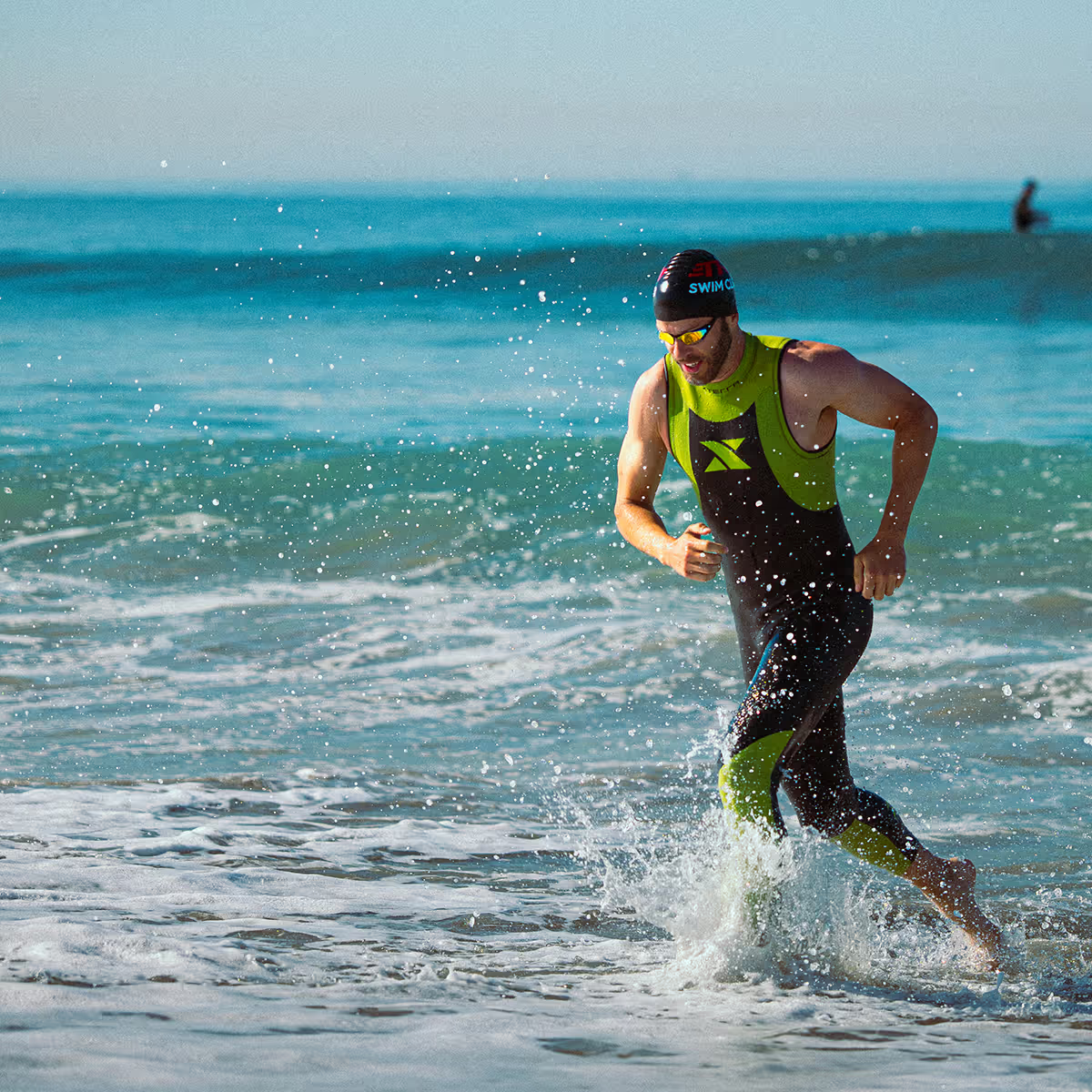
How Much Do I Need to Swim for a 70.3?
You signed up for a 70.3 and now the half Ironman swim feels real. How far is it, how often should you train, and how much is enough? The answers are simpler than you think.

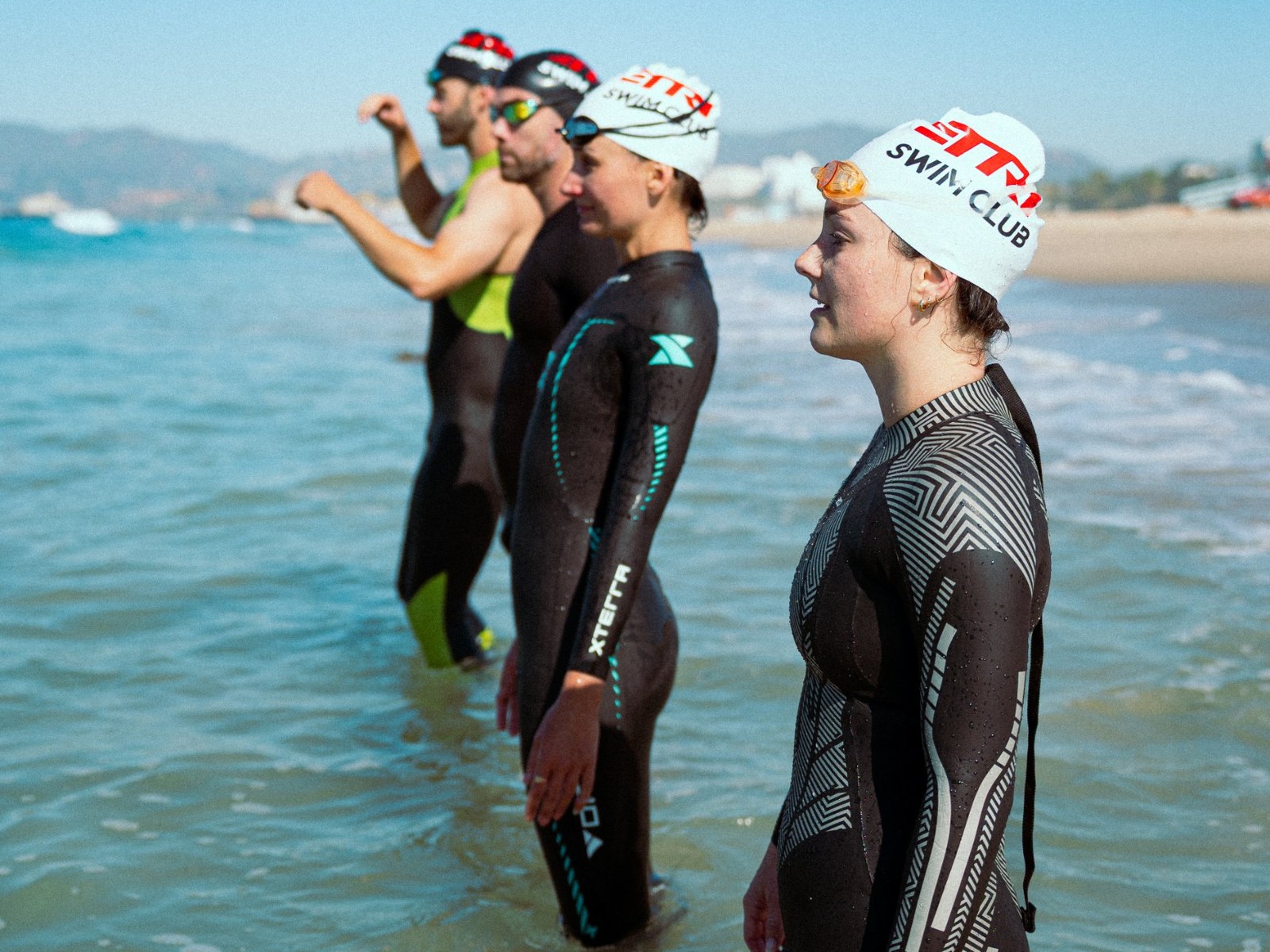
You signed up for a 70.3. Congratulations. And now that the confirmation email is sitting in your inbox, the swim is starting to feel a lot more real.
If you're like most triathletes, you've already typed some version of this into Google: How much do I actually need to swim? How many times a week? How long do I need to train? Do I need to swim the full distance before race day?
Good news. The answers are simpler, and a lot less time-consuming, than most training plans make them look. Let's go through them one at a time.
How Far Is The Swim In A 70.3?
The swim in a 70.3 is 1.9 kilometers, or 1.2 miles. That's about 2,100 yards, or 76 lengths of a 25-meter pool.
Most races give you 70 minutes to finish the swim, but check your race's athlete guide, because cutoffs can vary. For most triathletes, finishing isn't the real question. The real question is how to finish feeling calm, in control, and ready to ride.
How Many Times A Week Should I Swim For A 70.3?
At a minimum, twice a week. Three times a week is ideal.
Swimming is a feel sport. Your timing, your breathing, and your sense of the water fade fast when you're away from it. Two swims a week will keep you moving forward. Three swims a week is where things really start to click, because you're never more than a day or two away from the water.
And consistency matters more than any single session. Three swims a week, every week, beats five one week and one the next. It also beats the heroic Sunday swim that leaves you too tired for your long ride. I wrote more about that in why consistency beats the hero workout.
How Long Do I Need To Train For A 70.3 Swim?
Give yourself 16 weeks to prepare properly.
That's enough time to build your technique, your speed, and your race-specific fitness in the right order, without cramming.
If you're already pretty fit and a competent swimmer, you can make it work in 12 weeks. But 12 weeks is the shortcut, not the plan. If you're newer to swimming, or you're coming back after a long break, take the full 16. The extra month is cheap insurance.
How Far Should Each Swim Session Be?
Plan on about an hour per session.
Here's where I'm going to push back on how most people think about swim training. Total distance matters, but it's not the measurement you should be most concerned with. What happens inside that hour matters a lot more than the number on your watch at the end of it.
An hour of easy, unstructured laps at one speed will get you a big number and not much else. An hour with a real warm-up, focused technique work, a main set at the right efforts, and a proper cool-down might cover less distance, and it'll make you a lot faster. I call the first kind junk yardage, and it's the most common way triathletes waste their pool time. More on that in the time-crunched swim.
How Many Meters A Week Do I Need To Swim For A 70.3?
My minimum is roughly 4,000 meters a week.
That's about double the race distance, split across three sessions. So each swim is somewhere around 1,200 to 1,600 meters, depending on the day.
Why double? Because it's enough to build the skills and the confidence you need, without eating into the time and energy you need for your bike and run. You're a triathlete. You already build a huge aerobic engine on the bike and the run. You don't need to pile on easy pool volume to build a base you already have.
Four thousand meters a week is the floor, not the ceiling. Athletes chasing age group podiums should swim more. But if your goal is to finish the swim strong and confident, this is plenty, as long as you swim it with a purpose.
Do I Need To Swim The Full 1.9 km Before Race Day?
No. This one surprises people.
You don't need to prove you can swim 1.9 kilometers in training before you do it in the race. A marathoner doesn't run 26.2 miles before race day. They build the speed and fitness that make race pace feel manageable, and they trust it. Swimming works the same way. If you can comfortably swim your weekly sets at a pace faster than race pace, the race distance takes care of itself. Here's why your short swims already paid for your long one.
What Should My 70.3 Swim Workouts Include?
This is where most plans go wrong. They tell you how far to swim, and nothing about how.
A 70.3 swim start is chaos. Hundreds of people, arms and feet everywhere, no black line to follow, and a heart rate that wants to go through the roof. The athletes who panic aren't usually the least fit. They're the least prepared for what the start actually feels like. So your training needs to prepare you for that, not just for the distance.
Learn to control your heart rate. Everyone goes out hard in the first few hundred meters. The skill is being able to push early, get into a good position, and then bring your effort and breathing back under control without stopping. You practice that in the pool with sets that go hard, then settle.
Swim at different speeds. If you swim every session at the same comfortable pace, that's the only pace you'll have on race day. Your workouts should include some fast swimming, some race pace swimming, and some genuinely easy swimming. Speed is what makes race pace feel easy. I go deeper on that in the true cost of skipping speed work.
Use the clock. Train on send-off intervals, not fixed rest. It teaches you to know your pace by feel, which is exactly the skill that stops you from sprinting the first 400 and blowing up. Here's how in get faster with interval training.
Practice open water and sighting. The pool has walls, a black line, and clear water. Open water has none of that. Sighting, swimming straight without a line, dealing with chop, and staying calm when you can't see the bottom are all skills, and you only get them by practicing them.
How Often Should I Swim In Open Water Before A 70.3?
At least once a month during your build.
One open water session a month is the minimum to keep you comfortable with it. More is better, especially in the last six to eight weeks before your race. Use those sessions on purpose. Practice sighting every few strokes. Practice swimming next to someone. Practice a fast start and then settling into your pace. And if you'll be racing in a wetsuit, wear it for at least a few of those swims so race day isn't the first time you swim in it.
What Does A 70.3 Swim Training Week Look Like?
Here's how I'd structure three sessions totaling about 4,000 meters, which is my short track in the TRI Swim Club App. I split weeks into hard, medium, and easy days. Those labels are about how much the session taxes your nervous system, not how far you swim.
Day 1: Hard (about 1,200 meters). Speed work. Short, fast repeats with plenty of rest, plus some hard-then-settle efforts to practice controlling your heart rate after a fast start.
Day 2: Medium (about 1,600 meters). Your longest swim of the week, mostly at a steady aerobic effort and race pace, on a send-off. It's the most distance, but it's easier to recover from than the hard day.
Day 3: Easy (about 1,200 meters). Technique and drills, with some aerobic swimming.
Day 4 (optional open water): Medium (about 1,600 meters). A mix of open water specific training sets that prepare you for swimming longer periods with no walls, beach or floating starts with sprints, and more. We add optional open water workouts every other week in the app.
That's the whole week. Three hours of swimming, plus an optional open water session, and every one of them has a job to do.
The Short Version
Race distance: 1.9 km (1.2 miles)
Sessions per week: 2 minimum, 3 ideal
Time to prepare: 16 weeks, or 12 if you're already fit and a competent swimmer
Session length: about an hour
Weekly volume: roughly 4,000 meters minimum
Open water: at least once a month
What matters most: what's inside the hour, not the distance on your watch
Most triathletes overthink the distance and underthink everything else. They worry about whether they can swim 1.9 kilometers, then train by swimming slow laps until the number looks big enough. The athletes who have a great 70.3 swim do the opposite. They swim less, swim with a purpose, and show up on race day knowing exactly what the first 400 meters is going to feel like.
That's what you're really training for. Not the distance. The start.
Ready to see real progress in the water?
Follow structured weekly sessions that steadily build speed, endurance, and race control.
New to structured swim training?
Build confidence, improve technique, and double your distance before you join the TRI Swim Club.
Chasing podiums or performance goals?
Train with elite-level structure scaled to your ability with 1:1 coaching to compete at your highest level.