How to Swim Longer Without Getting Tired
You can run a half marathon but you're gassed after two lengths. It's not your fitness. Here are the five fixes that let you swim longer without getting tired, and how to build up to swimming nonstop.

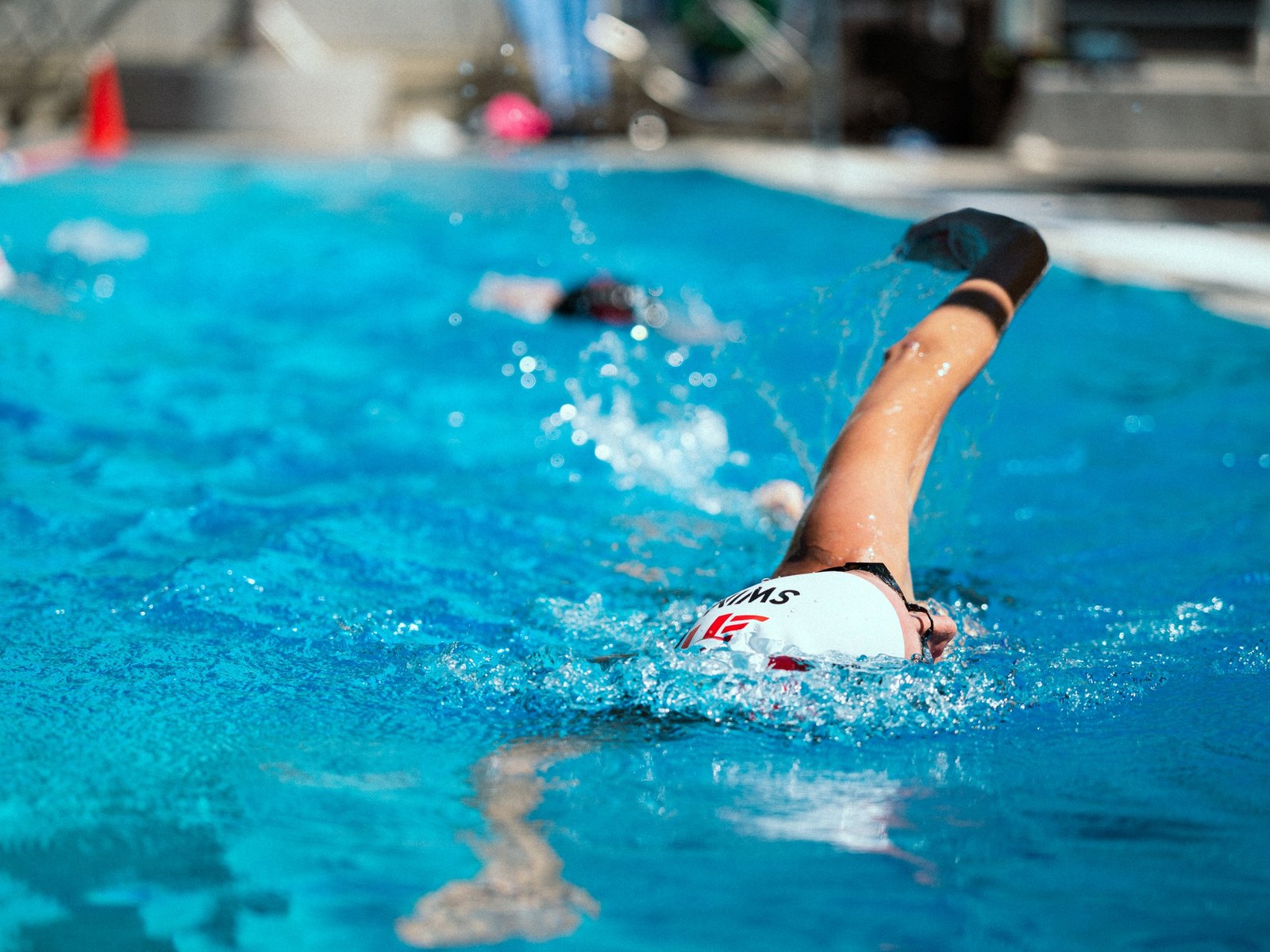
Picture a triathlete who can run a half marathon and ride for three hours without blinking. They get in the pool, push off the wall, swim one length, maybe two, and grab the wall at the other end gasping like they just sprinted up a flight of stairs. Then comes the question, with a mix of confusion and embarrassment.
"How is this possible? I'm fit."
You are fit. That's the strange part. And it's exactly why the answer to swimming longer without getting tired has very little to do with the kind of fitness you already have.
Why Do I Get So Tired When I Swim?
Because you're working way harder than you need to.
On land, your body knows how to move efficiently. You've been walking and running your whole life. In the water, every small mistake costs you energy. Hold your breath, and you starve your body of oxygen. Let your legs sink, and you drag them behind you like an anchor. Kick too hard, and your biggest muscles burn through your oxygen in a few lengths. Slip through the water with your hands, and you take twice as many strokes to go the same distance.
And there's a second piece to it. Every sport has its own specific fitness. It's not just your heart and lungs. It's your body and your nervous system adapting to one particular skill, until it can do that skill efficiently without wasting energy.
Here's the proof. Take a great swimmer who has never run and send them out for a half mile. They'll be gassed. Their engine is huge, but their body has no idea how to run efficiently. Now have them run every day for a few weeks, and that changes quickly. They build the specific fitness for running, and the half mile gets easy.
It works the same way in the other direction. Your running and riding built a great engine. They just didn't build swimming fitness. So getting tired in the pool isn't a sign that you're out of shape. It's a sign that your body hasn't learned to swim efficiently yet, and that comes from two things working together: cleaning up your technique, and swimming often enough for your body to adapt to it.
There are four big technique leaks, and they happen to go in the exact order I teach freestyle: breathing, kicking, body position, and catch.
1. You're Holding Your Breath
This is the number one reason triathletes get tired in the water, and most of them have no idea they're doing it.
Here's what usually happens. You put your face in the water and hold your breath. Then, when you turn to breathe, you try to breathe out and breathe in, all in the split second your mouth is above the water. You can't, so you get half a breath. Do that for a few lengths, and carbon dioxide builds up, your heart rate climbs, and you feel like you're suffocating. You're not out of shape. You're out of air.
The fix is simple. Breathe out the whole time your face is in the water. A slow, steady stream of bubbles through your nose and mouth, so that when you turn to breathe, most of the work is already done and the only job left is a quick breath in.
But don't push out every last bit of air. Breathe out naturally, the same way you do on land. When you're walking or running, you don't force out that last 20% of air before every breath, and you shouldn't in the water either. Forcing it all out is unnatural, and it'll make you gas out just as fast as holding your breath. It'll also make you sink. The air in your lungs is what helps you float, so empty them completely and your whole body drops lower in the water.
It sounds too easy to matter. It might be the single biggest change you ever make in the pool. I walk through it step by step in how to breathe while swimming.
2. You're Kicking Too Hard
Most triathletes kick one of two ways. Barely at all, or way too much.
The big, wild kick is the one that wears you out. Your legs are the biggest muscles in your body, and they use a huge amount of oxygen. Thrash them around from the knees and you'll burn through your energy in a few lengths, while barely moving any faster.
In freestyle, your kick's main job isn't to push you forward. It's to keep your legs up and your body in line. That takes a small, steady kick from the hips, like your feet have to stay inside a bucket. Keep it small, keep it relaxed, and keep it going. You'll be amazed how much energy you save.
3. Your Body Is Sinking
If your legs drag behind you, every stroke has to pull them through the water. That's a lot of extra work, and it adds up fast.
Your body in the water works like a teeter-totter, with your lungs as the pivot point. When your head comes up, your legs go down. So once you've fixed your kick in step 2, the fix usually isn't in your legs at all. Keep your eyes looking down at the bottom of the pool, press your chest slightly toward the bottom, and engage your core to lift your hips. When it's right, you'll feel your whole body sitting high and flat on top of the water, and swimming suddenly gets a lot easier. More on that in why do my legs sink when I swim.
4. Your Hands Are Slipping
Once your breathing, kick, and body position are in place, the last piece is your catch, the part of the stroke where your hand grabs the water and pushes it back.
A lot of triathletes slip their hand through the water instead of holding onto it. So they spin their arms faster and faster, taking more and more strokes, and going nowhere. It feels like work because it is work. It's just not very useful work.
A good catch means anchoring your hand and forearm and pushing water straight back past your hip. Each stroke moves you farther, so you need fewer of them. Fewer strokes for the same distance means less energy for the same swim.
5. You're Going Out Too Fast
Even with good technique, there's one more thing that tires people out. Starting too fast.
Most triathletes push off the wall at a pace they can hold for about 50 meters, then spend the rest of the swim hanging on. If you want to swim longer, start slower than you think you need to. Find a pace where you could keep breathing comfortably and keep going. It should feel almost too easy for the first few lengths. That's how you know it's right. Often with new swimmers, I recommend building your swims so you start easy and finish fast, rather than the other way around.
And relax. Tension costs energy. Loose arms, loose shoulders, loose neck. The swimmers who look the calmest are almost always the ones who can go the longest.
How Do I Build Up To Swimming Longer?
Here's where most triathletes go wrong. They try to build endurance by swimming as far as they can without stopping, every time, until they're exhausted. Then they do it again next time.
That's not how swimmers build endurance. Swimmers use intervals.
Instead of trying to swim 400 straight and dying at 150, swim 8x50 with 20 seconds of rest. Same distance, but now every length is swum with good technique, because you never get tired enough for it to fall apart. Then, over the next few weeks, turn your 50s into 75s into 100s. Then eventually, 200s.
Before you know it, you're swimming 400 repeats, not because you forced it, but because you built it. Every length along the way was a good one.
This works for the same reason it works for everything else in swimming. You're practicing the stroke you want, not the stroke you fall into when you're exhausted.
Is It My Fitness Or My Technique?
Usually, both. But not the kind of fitness you're thinking of.
If you can run or ride for an hour or more, but you can't swim 100 meters without stopping, your engine is fine. What's missing is technique and swim-specific fitness. Your stroke is leaking energy, and your body hasn't adapted to swimming yet. Fix the leaks and swim consistently, and both come along together.
If you can swim a few hundred meters comfortably but fade after that, your technique is working and now it's about building your swimming fitness further. That's when structured interval training really takes off.
Either way, the fix isn't more laps. It's better laps, swum often enough that your body learns them.
Double Your Distance
If you're the triathlete who's gassed after a length or two, I built a program for exactly you.
It's called Double Your Distance. It's a four-week course that walks you through the same four fixes in this post, one week at a time, in the same order: breathing in week one, kicking in week two, body position in week three, and your catch in week four. Each week has the drills and the workouts to make that fix stick, so by the end, you're not just swimming farther. You're swimming easier.
It's a one-time purchase with lifetime access, and it's built for beginners and anyone who feels like they're fighting the water every time they get in. You can find it on the TRI Swim Club program page.
But whether you join or not, start with the first fix. Next time you're in the pool, swim one length and focus on nothing but breathing out the whole time your face is in the water. Then swim another.
Most triathletes don't need a bigger engine to swim longer. They need to stop holding their breath.
Ready to see real progress in the water?
Follow structured weekly sessions that steadily build speed, endurance, and race control.
New to structured swim training?
Build confidence, improve technique, and double your distance before you join the TRI Swim Club.
Chasing podiums or performance goals?
Train with elite-level structure scaled to your ability with 1:1 coaching to compete at your highest level.