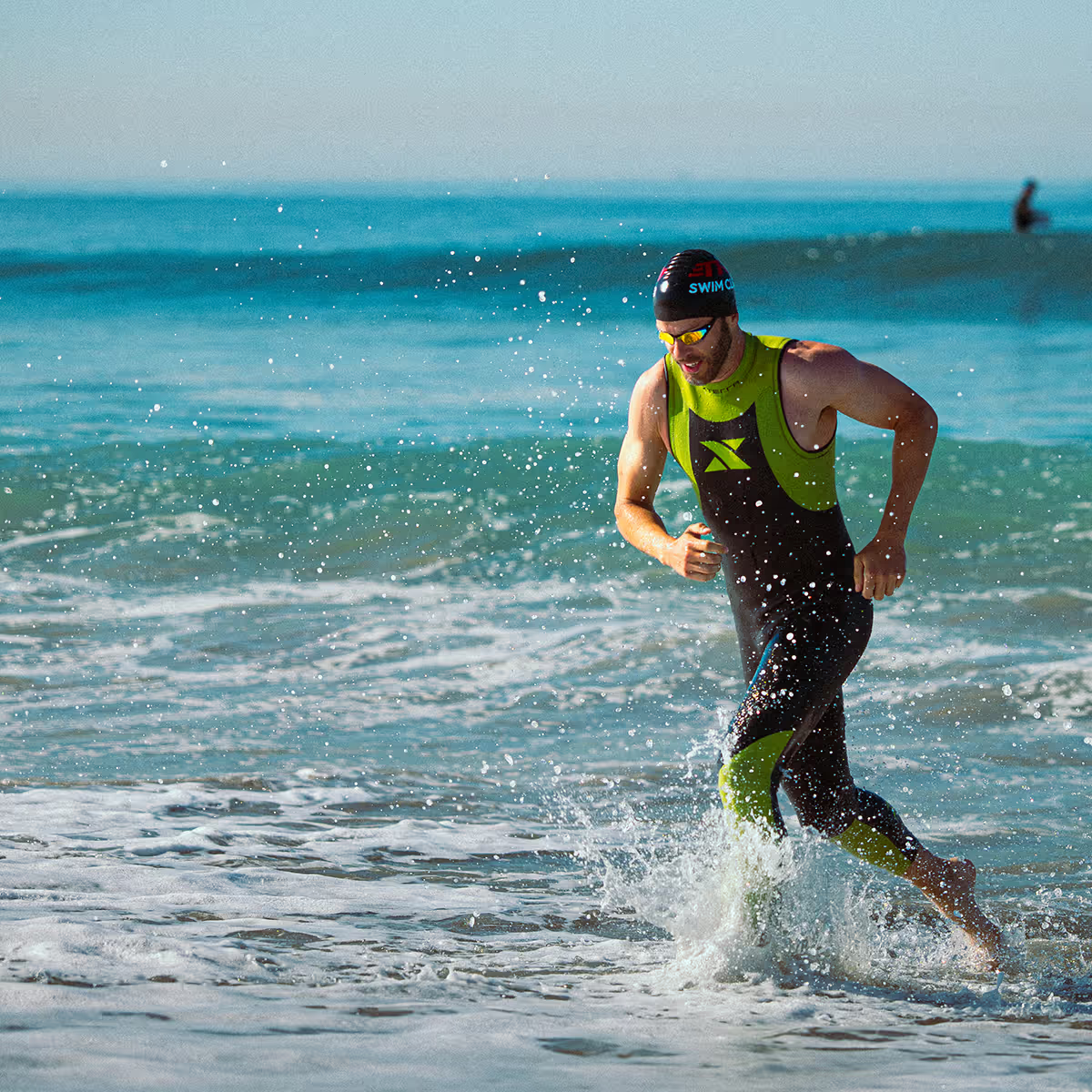
Dude, Where's My 12 Seconds?
TRI Swim Club athletes drop an average of 12 seconds per 100 meters in 16 weeks. But test yourself in week three and you might see nothing. Here’s why swim progress is bumpy up close and steady from far away.


On average, the athletes I coach drop about 12 seconds per 100 meters over a 16-week training cycle.
It's a nice number, and I use it a lot because it makes the math easy. Twelve seconds per 100 turns a 1:55 swimmer into a 1:43 swimmer. Over a 70.3 swim, that's nearly four minutes. Over a full Ironman, it's more than seven. Minutes you get back without buying a single new wheel.
But to get a number like that, I'm describing a whole training cycle. Sixteen weeks of swims, stacked one on top of the other, adding up to something you can see on race day.
Is that realistic? Some people think I'm being optimistic. Twelve seconds sounds like something from an infomercial, and they've been swimming the same pace for five years. Other people think I'm being pessimistic. They dropped 20 seconds in their first month and want to know why I'm selling it short.
They're both a little bit right. And the reason why is the most important thing to understand about swim training.
The Week Nothing Happens
Here's what the skeptics get right.
If you test your swim after week three, there's a good chance nothing has moved. You might even be slower. You show up to your test set, you swim your hardest, and the clock tells you the same thing it told you a month ago. All that work, and nothing to show for it.
That's not a sign the plan is broken. It's a sign the plan is working the way it's supposed to.
A TRI Swim Club cycle runs in four phases, each about four weeks long, and each one has a different job.
Base building. We start by building your aerobic base and cleaning up your technique. Your times don't drop much here, and they're not supposed to. You're laying the foundation everything else gets built on.
Front-end speed. Then we raise your ceiling with short, fast repeats and plenty of rest. Your top speed goes up. But speed work is hard on your body, and the fatigue it builds can hide the fitness underneath. You can be getting faster, but feel slower on your long sets at the same time.
Back-end speed and pacing. Next we stretch that speed out into a pace you can hold. Longer repeats, shorter rest, and a lot of practice learning what race pace feels like. This is usually where seasoned athletes start to notice something is happening.
Peaking and taper. Finally, we sharpen up and cut back so all that fatigue goes away. And this is where the 12 seconds tends to show up, all at once, right when you need it.
So if you judge your training by any single week, you'll find plenty of weeks where it looks like nothing happened. Your progress is real. It's just hiding under the fatigue.
The Time Machine Test
Here's a way to picture it.
Imagine you could go back through every week of every athlete I've coached and check their swim times. Not just at the end of a cycle, but week by week.
Look at any one week, and you'll see everything. Fast weeks, slow weeks, weeks where someone was sick, traveling, or up all night with a newborn. One week tells you almost nothing.
Look at any four-week block, and the picture gets clearer. Most blocks move forward. Some don't, especially the ones that land in the middle of a hard speed phase.
Look at a full 16-week cycle, and it's a different story. The bumps smooth out. The bad weeks get absorbed by the good ones. And the athletes who stuck with it come out the other side faster.
That's the whole secret. Swimming progress is bumpy up close and steady from far away. The 12 seconds isn't a promise about any one Tuesday. It's what happens when you add up sixteen weeks of them.
Why 12 And Not 20?
Twelve seconds is an average, so some athletes drop more and some drop less.
Newer swimmers and athletes who've been training with no plan at all usually drop more. A lot of them come in closer to 20 seconds per 100, because there's so much easy speed sitting on the table. I wrote about that in the real cost of not having a training plan.
Experienced swimmers usually drop less. When you've been swimming for years, every second is harder to find. For them, three or four seconds per 100 can be a huge season, and it changes their whole race.
So if you're new and you drop 20, great. And if you're experienced and you drop five, that might be the best five seconds you've ever earned. The average is just the average.
What If Your Cycle Goes Sideways?
Life doesn't care about your training plan. You'll get sick. Work will get busy. A kid will stop sleeping. And sometimes a whole cycle just doesn't go the way you wanted.
The answer is to stay flexible.
Don't panic and pile on extra volume to catch up. That's the most common mistake I see, and it usually makes things worse. All that extra volume does is bury your progress under more fatigue. I wrote about that in training volume: a tax on triathletes who don't trust their plan.
Don't skip the taper or deload weeks, either. The rest is where the gains show up. Cut them short, and you're showing up to race day carrying all the fatigue that was hiding your fitness in the first place.
Instead, adjust. Change distance tracks. Swap a hard day for a medium one. Miss a few days if you have to, and pick back up where you left off. Consistency over months beats perfection over weeks, every time. More on that in why consistency beats the hero workout.
And Then You Do It Again
Here's the part most people miss. The 12 seconds isn't the end. It's the new starting line.
Your next cycle starts from a faster base than your last one. Your speed phase starts from a higher ceiling. Your race pace starts from a faster pace. And you get to go through the whole cycle again, with all the bumps, from a better place.
That's how swimmers get fast. Not in a week. Not in a month. One cycle at a time, stacked on top of each other, for as long as you keep showing up.
So here's what I want you to do. Swim a test this week. Something simple, like a timed 400 or a set of 100s you can repeat. Write the number down somewhere you won't lose it, then forget about it. Don't check it in week three, when you're tired and nothing seems to be working. Check it in week sixteen.
The 12 seconds is in there. You just have to stay in the water long enough to find it.
Ready to see real progress in the water?
Follow structured weekly sessions that steadily build speed, endurance, and race control.
New to structured swim training?
Build confidence, improve technique, and double your distance before you join the TRI Swim Club.
Chasing podiums or performance goals?
Train with elite-level structure scaled to your ability with 1:1 coaching to compete at your highest level.